
The sameness problemA plain way to find the difference customers will pay for.What makes my business different from everyone else’s?
Find the real constraint first. Then find, prove and repeat the one difference your customers would name themselves.
Written by Kevin D’Ambros-Smith, Founder, Simple-Growth. Updated 20 November 2026.
The short answer
What makes your business different is the thing your customers would name, unprompted, that a competitor could not truthfully claim. Find it by asking five real customers why they chose you and what else they considered, then run the Swap Test: if a rival could say your line, it is not a difference yet. Kevin D’Ambros-Smith’s Simple-Growth method finds the real constraint before you rewrite a word or spend a dollar.
Customers ask for a discount before they ask what you do.
You went into business for income, time, freedom, wealth, or all four. Now a prospect has asked for a better price before asking what you actually do, your website could belong to any competitor, and the advice arrives from every side: ‘niche down’, ‘post more’, ‘just be authentic’.
The villain here is not your product, and it is not your marketer. It is the habit of describing yourself in words a rival could borrow. Our guide to finding your real business constraint is where the method starts. Why has my business stopped growing? covers a flat year, and how to get your business to run without you covers the owner-dependent business. This page applies the same method when the constraint is that nobody can tell you apart.
On the other side of this page: you have one sentence your customers would repeat, a proof you can show for it, and a quick test to keep it honest.
How hard is it to stand out right now?
All three figures come from vendor-run surveys of North American samples, not a New Zealand census, so read them as signals rather than proof. They point one way: polish is now cheap and proof is scarce. The checks below use only your own customers.
Why can’t customers tell you apart? Match your situation.
Find your situation, then run the first check. Your numbers decide, not this table. Not sure where to start? Make five customer calls.
| Your situation | Likely cause | First check | Number to track | Read next |
|---|---|---|---|---|
| Prospects ask for a discount before they ask what you do | Price is the only visible difference | Note who raised price first in your last ten quotes | Quotes where price came up first | Nobody can tell you apart |
| Your website could belong to any competitor | Claims a rival could repeat | Swap a competitor’s name into your homepage | Claims that still read true with their name | The Swap Test |
| You can’t say what you do best in one sentence | No chosen position | Ask five customers what else they considered and how they would describe you | Words repeated by three or more customers | Five customer calls |
| Your marketing sounds like everyone else’s AI content | Polish without proof | Count the named proofs on your site: customers, numbers, promises | Proofs a competitor could not copy | Prove it isn’t AI-written |
| You say ‘we care about service’ | Service is a standard, not a position | Ask what a customer would miss if you vanished | Customers who can name one specific thing | Why good service isn’t a position |
| Revenue is climbing but margin is thinning | An unpriced difference | Compare margin by customer type | Gross margin by customer segment | Margin is a positioning problem |
| You market to everyone | No chosen customer | List your best ten customers and what they share | Share of revenue from your best ten | Marketing to everyone |
| You wrote your difference down and no one remembers it | Not proved or repeated | Ask your team to state it without looking | Team members who give the same answer | Why no one remembers it |
How do you find what makes your business different?
Big brands write their position on one page and defend it. The same discipline works at small-business scale in five steps.
1. Ask five customers
Include one who nearly didn’t buy and one you lost. Ask what else they considered. Five customer calls shows how.
2. Tally their words
Write down the alternative they named, why they chose you and how they described you. Keep anything three people repeat.
3. Write the one-line test
Unlike the alternative they named, you do the thing they repeated, for the customers who said it. See five questions to answer this week.
4. Run the Swap Test
Put a competitor’s name in place of yours. If it still reads true, keep working. The Swap Test.
5. Prove it, then repeat it
Attach a named customer, a tracked number or a promise with a cost, then say it the same way everywhere. Proof beats polish.
Where does Kevin’s thinking on positioning come from?
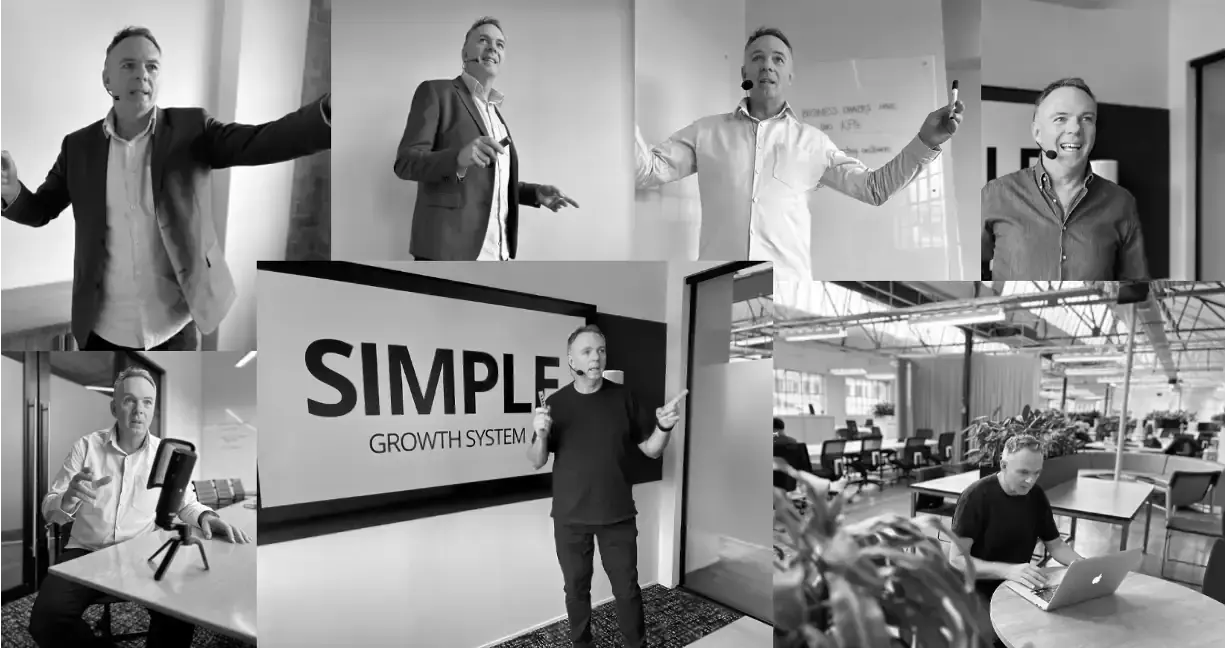
Kevin spent years inside DDB, Ogilvy and Saatchi and Saatchi working across 60+ global brands, where a position was something you could write on one page and defend in the room. He has since founded or co-founded nine companies and coached 200+ businesses one-on-one across 30+ industries. The Simple-Growth method brings that discipline down to small-business scale: find the real constraint first, then fix it before another dollar is spent.
Meet Kevin on kevindambros-smith.com, or see how he works with one-on-one coaching.
Don’t take our word for it.
Owners on what it’s like to work with Kevin.
“Kevin worked with us at PhysioACTION to develop a positioning that sets us apart, 'PhysioACTION - A better experience', then helped us build the experience to match. In every part of the business we ask how to make it better for our customers and our team, and that's now the standard we hold ourselves to.”
“He was my coach when Covid kicked off. We decided to rebrand then, and put everything under one brand. With his background, I don't think the ROW branding would be nearly as strong without his input.”
“Kevin helped us understand Marketing and develop a strategy for the business that captured the true essence of the M2 Overland Brand.”
+72
Net Promoter Score from coaching clients surveyed through The Icehouse
200+ businesses coached one-on-one, across 30+ industries. From 7-figure operators to companies turning over $100m+ a year.
Backed by 30+ years in business, 60+ global brands and 3 global agencies.Go deeper: guides to standing out.
Each guide takes one reason customers can’t tell you apart.
Five customer calls that show what makes you different
Who to call, three questions and a tally sheet.
Everyone assumes your marketing is AI-written
Five proofs an AI can’t invent for you.
Does your marketing sound like everyone else’s?
Why your business sounds like everyone else’s AI content
The writing side of sameness.
Why good service isn’t a business position
And what actually is.
Big-brand positioning on a small-business budget
Five questions to answer this week.
Nobody can tell you apart, so they ask for a discount
Why sameness invites the price question.
Why competing harder is the wrong strategy.
You sound credible, you just don’t sound different
The sentence that fixes it.
Your margin isn’t a pricing problem
It’s a positioning problem.
Why sameness is the real price war.
You wrote down what makes you different
So why does no one remember it?
Building a better experience into every part of the business.
Questions owners ask.
What makes a business different from its competitors?
Something a customer would name unprompted and a rival could not truthfully claim. It is usually a mix of who you serve, how you do the work and what you can prove, not a slogan.
How do I find out what makes my business different?
Call five customers, including one who nearly did not buy and one you lost. Ask what else they considered, what they would have done without you and how they would describe you to a friend. Words repeated by three people are your starting point. See five customer calls.
How do I know if my difference is real?
Run the Swap Test: put a competitor’s name in place of yours. If it still reads true, it is not a difference yet. Then ask whether you can prove it with a named customer, a tracked number or a promise with a cost. Read the Swap Test.
Is price a way to differentiate?
It can be, but it is the easiest position to copy and the hardest to defend, because a bigger rival can usually go lower. Most owners who compete on price have not yet found another difference customers would pay for. See why sameness is the real price war.
Does AI-generated marketing make it harder to stand out?
A 2026 Cashew Research survey of 2,149 consumers in the US and Canada found 87% assume brands use at least some AI-made content, and a separate survey of 206 North American marketers found 65% report differentiation anxiety. Both are vendor-run samples, so treat them as signals. The practical answer is to lean on proof an AI cannot invent. See how to prove it.
How long does it take to find what makes my business different?
Five customer calls take about a week. Turning the result into a one-line position and testing it takes another week or two. Results vary with the business and with how consistently the position is repeated.
When is a business coach worth it?
When customers can’t tell you apart but you can’t see which link to fix first, or when you keep rewriting your message without results changing. A free 30-minute call will tell you whether coaching fits. See what a business coach costs.
Keep exploring.
More on how Kevin works with ambitious owners.
Find your real business constraint
The pillar guide to the method.
Why has my business stopped growing?
Five checks for a flat year.
How do I get my business to run without me?
Checklists, owners and numbers.
How can my small business use AI to grow?
Point AI at the weak link, not the loudest tool.
Free training: The World’s Greatest Sales Line
A short free lesson you can use this week.
Online programmes: launching soon
Join The Inside Track to hear first.
Find the real constraint, build a 90-day plan and work it together.
Kevin’s story and credentials, on kevindambros-smith.com.
Get Started
Back yourself. Run the system.
Bring your five customer answers and your best guess at the weak link. In a free 30-minute call, Kevin will help you see which link is limiting the rest and what to test this fortnight.
- Free, no-obligation 30-minute conversation
- An honest view from 30+ years in business and 9 companies founded or co-founded
- No pressure. If coaching is not your answer, Kevin will say so
Become the business customers can describe in one sentence.
Pick a time that suits you. Kevin works from Auckland, New Zealand, and meets owners online across New Zealand and US time zones.
Book my free 30-minute call